Can I Run Muse Spark Open Locally? Two 512 GB Macs, or Four 256 GB
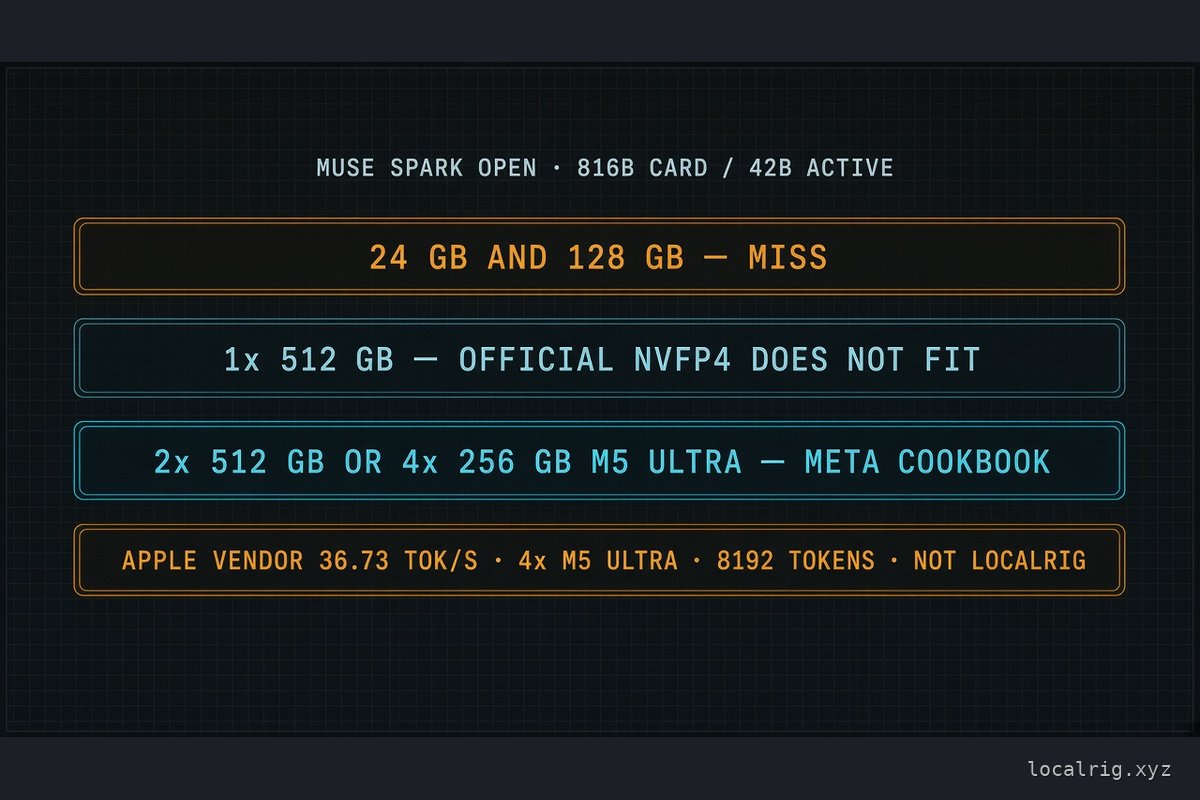
Short answer: Meta’s card states Muse Spark Open at 816B total and 42B active. Hub safetensors total: 822,036,529,664. NVFP4 shards: 533.011 GB. The Mac cookbook requires two 512 GB or four 256 GB M5 Ultra Studios. A 24 GB card and a 128 GB Mac miss. Apple lists 36.73 tok/s on four M5 Ultras at 8,192 tokens. LocalRig has not measured tok/s.
meta-models/Muse-Spark-Open-816B-A42B is the open-weight checkpoint. The model card (release date October 15, 2026, Muse Model License) calls it an 816B total / 42B active mixture-of-experts transformer with a perception encoder. Context on that card is 1M at inference. Input on the card is text, image, video, and audio. Output is text. The Hub safetensors block, read 2026-10-21, counts 822,036,529,664 parameters (821,906,490,368 BF16 and 130,039,296 F32). Those two parameter totals are both on the record. This page does not average them. The safetensors block does not split out an active-parameter count, so 42B active stays a model-card figure.
This is a constraint selector. Muse Glimmer 30B is the dense sibling that has a 24 GB cell. Spark Open is not that download. Qwen 3.8 27B stays the LocalRig 24 GB dense default.
What was checked, and what was left unmatched
Answer from the card, Meta’s docs, Apple’s research post, the Hugging Face tree API, and the Fireworks pages. All of those were read on 2026-10-21 except Apple’s post, which is dated 2026-10-15. Decimal GB below is bytes / 10^9. GiB is bytes / 2^30, and it is labeled when a source uses it.
Three weight figures for the same NVFP4 checkpoint do not match, and this page keeps all three:
| Source | What it says about NVFP4 weights | What it says about BF16 weights |
|---|---|---|
| Hugging Face tree, weight shards only, 2026-10-21 | 533,011,023,472 bytes (533.011 GB, 496.404 GiB), 127 shards | 1,644,333,393,864 bytes (1,644.333 GB, 1.644 TB), 65 shards |
| Meta, Get the model | About 537 GB. KV, activations, and runtime overhead are extra | About 1.65 TB. Same exclusion |
| Apple ML Research, 2026-10-15 | About 493 GB, then intermediates, and it does not fit one Mac | More than 1.6 TB for the parameters alone |
| Model card, “run on your own system” | At least 700 GB of VRAM | 2 TB of VRAM |
The 700 GB and 2 TB lines are the card’s system floors. They are not file sizes. Meta’s 537 GB and Apple’s 493 GB are both “about” figures. The shard sum is the only byte count LocalRig added up, and it was added from the public tree, not from a weight download. config.json on the official repo returned 401 on 2026-10-21, so this page does not quote a context field from that file. The card’s 1M and Meta’s vLLM example flag --max-model-len 1048576 are the context cites.
Official repos meta-models/Muse-Spark-Open-816B-A42B and ...-NVFP4 are gated: manual on the Hub API. The tree still returned file sizes. Community GGUF and MLX repos below were gated: false.
Hardware and quant fit
| Path | Checkpoint | Figure the source actually gives | How that source treats the fit | Speed |
|---|---|---|---|---|
| 24 GB GPU | Smallest sized file, Unsloth UD-IQ1_S | 175.640 GB of GGUF shards | The file is larger than 24 GB. No smaller file in the repos sized here | None published here |
| 128 GB unified | Same file | 175.640 GB | The file is larger than 128 GB | None |
| One Mac, 512 GB sticker | Official NVFP4 | Shard sum 533.011 GB. Apple: about 493 GB plus intermediates | Cookbook is not a one-Mac recipe. Apple says it does not fit one machine. The shard sum is already over 512 GB | None for one box |
| One Mac, 512 GB | ggml-org Q2_K | 304.080 GB | Card note: “Fits in 512 GB of unified memory.” Community, one card. No KV size | None |
| One Mac, 512 GB | mlx-community oQ3e | 371.485 GB | Card: about 372 GB on an M3 Ultra 512 GB in oMLX, “leaving room for the KV cache.” Audio encoder is absent. No KV number | None |
| One Mac, 512 GB | mlx-community oQ4e | 477.607 GB | Card warning: about 478 GB, more than one 512 GB Mac can run reliably | None |
| One Mac, 512 GB | mlx-community 4-bit | 532.781 GB | Card: about 533 GB, more than the memory of one 512 GB Mac | None |
| Two M5 Ultra, 512 GB each | Official NVFP4, MLX | Cookbook hardware line | Meta’s supported pair. Each Mac needs the full checkpoint on disk | Apple’s 2-node rows do not print GB per Mac |
| Four M5 Ultra, 256 GB each | Official NVFP4, MLX | Cookbook hardware line | Meta’s other supported set. Meta says four Macs serve fastest | Apple’s 4-node rows do not print 256 GB |
| 4× B300 | Official NVFP4, vLLM or SGLang | TP4/EP4. Card floor 700 GB VRAM | Meta serving recipe | No tok/s in these docs |
| 8× B300 | Official BF16 | TP8/EP8. Card floor 2 TB VRAM | Meta serving recipe | No tok/s in these docs |
| Fireworks serverless | accounts/fireworks/models/muse-spark-open | $1.25 / $0.15 / $4.25 per 1M tokens (input / cached input / output), read 2026-10-21 | Page state Ready. Not a local fit | No tok/s on the page |
A 24 GB card and a 128 GB Mac are out on file size alone. The next sections keep the Mac, multi-GPU, and hosted rows attached to the page that stated them.
Mac clusters: cookbook hardware, then Apple’s speed table
Meta’s Mac cookbook, read 2026-10-21, is the hardware requirements page for a local MLX serve.
The prerequisites on that page:
- Two Mac Studio computers with M5 Ultra and 512 GB of unified memory each, or four with 256 GB each.
- macOS 26.2 or later on every Mac.
- MLX 0.30.1 or later.
- A direct Thunderbolt 5 link between every pair. The page says to connect each pair with two cables to double link bandwidth. With four Macs, every Mac connects to each of the other three.
- Disk space for the full NVFP4 checkpoint on each Mac. The serve command uses
meta-models/Muse-Spark-Open-816B-A42B-NVFP4. - The page says the model does not fit in one Mac’s memory, and that four Macs serve fastest.
The per-Mac disk line is a full copy, not a split file. The weight-shard sum is 533.011 GB per copy. LocalRig did not measure filesystem overhead on top of that sum. The cookbook does not publish tok/s.
Apple’s research post (2026-10-15) is a vendor speed table for the same model id, NVFP4, mlx_lm.benchmark, MLX v0.30.1 and later, and RDMA over Thunderbolt via jaccl. The caption says decode was measured over 128 generated tokens after the context. The caption does not print a batch size on the Muse rows. The post’s example command, which is for Qwen 3.8, uses -b 1 -g 128. That example is not a Muse batch citation. The post also does not print the unified-memory size of the Macs in the speed tables. A single Mac Studio is described as up to 512 GB, and Muse is the model that does not fit one machine. Do not paste the cookbook’s “512 GB” or “256 GB” onto Apple’s tok/s cells. They are separate sentences.
There is no three-Mac row. The published matrix is two-machine pipeline, two-machine tensor, and four-machine tensor.
Decode, tokens per second, Apple Table 3. Higher is the vendor’s better. Single-machine cells are an em dash on the page.
| Context | 2× M5 pipeline | 2× M5 tensor | 4× M5 tensor |
|---|---|---|---|
| 8,192 tokens | 15.74 | 24.99 | 36.73 |
| 65,536 tokens | 14.37 | 23.84 | 34.66 |
Time to first token, seconds, Apple Table 2. Lower is the vendor’s better.
| Context | 2× M5 pipeline | 2× M5 tensor | 4× M5 tensor |
|---|---|---|---|
| 8,192 tokens | 8.4 | 8.2 | 4.8 |
| 65,536 tokens | 47.6 | 70.3 | 40.6 |
The 36.73 figure is the 8,192-token, four-Mac, tensor row. At 65,536 tokens the same column is 34.66. Apple’s prose says that at 65,536 tokens, two-machine tensor parallelization lags two-machine pipeline on prefill for this model. The table matches that sentence: 70.3 s versus 47.6 s. On four M5 Ultras at 65,536 tokens, Apple says two cables per link cut TTFT from about 50.5 s (one cable, called an additional experiment) to 40.6 s (the two-cable value in Table 2).
These rows are one vendor’s table. LocalRig has not run mlx_lm.benchmark on this model. The older Mac Studio cluster page is a different cite packet, on different machines and different models. Do not move its tok/s onto this one.
Community GGUF and MLX files
File sums are Hugging Face tree totals for the weight shards named below, read 2026-10-21. mmproj files are separate and are not inside those sums.
ggml-org Muse-Spark-Open-816B-A42B-GGUF. The card’s rounded sizes are in the last column. Meta’s deploy page names Q4_K_S, Q8_0, and Q2_K as the three quants for llama serve.
| Quant | Files | Bytes | Decimal GB | Card’s size line |
|---|---|---|---|---|
Q2_K | 22 | 304,080,474,208 | 304.080 | 304 GB. Card: fits in 512 GB unified memory |
Q4_K_S | 22 | 470,069,227,350 | 470.069 | 470 GB |
Q8_0 | 10 | 871,648,188,873 | 871.648 | 872 GB |
BF16 | 22 | 1,640,264,556,374 | 1,640.265 | 1.64 TB |
mmproj on that repo: BF16 4,097,601,888 bytes (4.098 GB), F16 4,095,795,552 (4.096 GB), Q8_0 2,183,868,768 (2.184 GB). The card rounds those to 4.1 / 4.1 / 2.2 GB. The only “fits in 512 GB” sentence on the card is attached to Q2_K. It is not extended here to Q4_K_S. No tok/s is on the card.
Unsloth Muse-Spark-Open-816B-A42B-GGUF. Same mmproj byte sizes as ggml-org for BF16, F16, and Q8_0.
| Quant | Files | Bytes | Decimal GB |
|---|---|---|---|
UD-IQ1_S | 5 | 175,639,574,392 | 175.640 |
UD-IQ1_M | 6 | 208,925,571,064 | 208.926 |
UD-IQ2_XXS | 6 | 225,568,569,304 | 225.569 |
UD-IQ2_S | 7 | 275,497,564,280 | 275.498 |
UD-Q2_K_XL | 8 | 311,225,649,368 | 311.226 |
UD-IQ3_XXS | 8 | 340,350,896,376 | 340.351 |
UD-Q3_K_XL | 10 | 401,483,491,832 | 401.483 |
UD-Q4_K_XL | 12 | 505,502,231,288 | 505.502 |
Meta’s deploy page quotes Unsloth planning ranges for total memory (system RAM plus VRAM, or unified memory). Meta says the ranges vary with quant, context, KV format, and runtime. They are not the file sums above.
| Quant band on Meta’s page | Approximate total memory |
|---|---|
| 2-bit | 300–315 GB |
| 3-bit | 365–390 GB |
| 4-bit | 470–500 GB |
| 6-bit | 670–700 GB |
| 8-bit | 870–950 GB |
UD-Q4_K_XL on disk is 505.502 GB, which sits above the 470–500 GB band. UD-Q2_K_XL is 311.226 GB, inside the 2-bit band only if you ignore KV. The tree had no 6-bit or 8-bit Unsloth GGUF on 2026-10-21, so those two bands have no file sum here. Meta’s example command uses :UD-Q2_K_XL and --context-length 32768, and the page says that context is there to limit KV memory. It is an example, not the 1M maximum. BF16 language-model weights alone are “approximately 1.63 TB” on that same page, which is a third BF16 wording next to 1.644 TB of official shards and “about 1.65 TB” on the get-the-model page.
mlx-community, all four cards say mlx-lm 0.32.2 (re-uploaded 2026-10-16). That pin is newer than the cookbook’s MLX 0.30.1 floor for the official NVFP4 serve. Do not treat them as one version.
| Repo | Weight-shard bytes | Decimal GB | What the card says |
|---|---|---|---|
...-4bit | 532,781,033,893 | 532.781 | About 533 GB. More than one 512 GB Mac. Vision included. Experts in layers 1–60 at 4-bit, the rest BF16 |
...-3bit | 436,144,269,791 | 436.144 | About 436 GB. Vision included. The card does not claim a one-Mac fit |
...-oQ4e | 477,607,476,861 | 477.607 | Card total 477.607 GB. Warning: about 478 GB, not reliable on one 512 GB Mac. Vision included. Audio encoder not included |
...-oQ3e | 371,485,110,533 | 371.485 | Card total 371.485 GB. About 372 GB on an M3 Ultra 512 GB in oMLX, with room left for KV. No KV size. Audio encoder not included |
The oQ3e and oQ4e byte sums match the totals printed on those cards. The “fits” and “does not run reliably” lines are the cards’ own words. They are single-source community claims. LocalRig has no peak memory and no tok/s for any of them.
No separate vLLM weight repo turned up in a Hub search for Muse-Spark-Open on 2026-10-21 (33 repos returned). vLLM’s path on Meta’s deploy page is the official NVFP4 or BF16 checkpoint, not a third quant family. The NVFP4 server example is vllm serve meta-models/Muse-Spark-Open-816B-A42B-NVFP4 with --tensor-parallel-size 4, --enable-expert-parallel, and --max-model-len 1048576. BF16 on that page is --tensor-parallel-size 8 on 8× B300. SGLang’s NVFP4 command on the same page is --tp-size 4 --ep-size 4. The get-the-model table pairs those recipes with 4× B300 (NVFP4) and 8× B300 (BF16). LocalRig has no B300 VRAM capacity and no B300 rental price in this check. The H100 rental comparison is a different accelerator.
Hosted, if the weights are the wrong purchase
Fireworks, read 2026-10-21:
- Model page: fireworks/muse-spark-open. State Ready. Created 2026-10-14. Kind: base model. Provider: Meta. Hugging Face id:
meta-models/Muse-Spark-Open-816B-A42B. - Serverless price on that page: $1.25 / $0.15 / $4.25 per 1M tokens (input / cached input / output).
priceDateon this article is the day that page was read. - The page lists context 1040k tokens, input text and images, output text, function calling supported. The model card’s context line is 1M, and the card’s inputs include video and audio. Both listings stay as written.
- The Fireworks blog is published 2026-10-20 and says the model is on the serverless API on US-only capacity, with the price left to the model page. LocalRig did not send a request, so “Ready” is the page’s state, not a completed call.
The Hub model page fetched the same day names Baseten as an inference provider. No Baseten price was on that fetch. The model card says the model is available via API through third-party inference providers and does not, in the text read here, list prices.
Marketing scores on the Fireworks blog (legal, finance, clinical) are not repeated here. They are not a hardware measurement.
License, in one paragraph
The weights are under the Muse Model License, version text dated October 15, 2026, not Apache-2.0. The license text requires a product or service that uses the software or a derivative to display “Built with Muse Spark Open” in the interface or in the docs, site, or settings. It also sets a separate-agreement condition for model-as-a-service once the licensee’s aggregate gross revenue exceeds twenty (20) million US dollars in any consecutive twelve months. The usage policy says Muse Spark Open is not intended for individuals under 18. Read the license on the model card before shipping a product. The revenue line is a license term. The dollar figures dated on this page are the Fireworks token prices.
What to run instead
24 GB: Muse Glimmer 30B is the Muse-family cell with a published 19.0 GiB stack at 131,072 tokens. Qwen 3.8 27B remains the dense default. Spark Open’s smallest confirmed file, 175.640 GB, does not become a 3090 file by waiting on a lower quant that was not in the tree.
128 GB unified: still under the smallest confirmed file. The Unsloth 2-bit planning band on Meta’s page is 300–315 GB.
One 512 GB Mac: the official NVFP4 path is a no, from both the cookbook and Apple, and the shard sum is over the sticker. The only “fits” sentence LocalRig found for a single 512 GB pool is ggml-org’s Q2_K card note, plus the oQ3e card’s about-372 GB line for an M3 Ultra in oMLX. Neither ships a tok/s.
Two or four Mac Studios: the cookbook is the requirements page. Apple’s table is the only tok/s, and it is vendor, single-source, with the memory sticker unpublished on the rows. The broader cluster write-up, with its own and older cites, is Mac Studio clusters over Thunderbolt 5.
No local box: Fireworks’ priced serverless row above, or another host you price yourself. Rent-versus-buy accounting for GPUs you do own is the break-even page. The constraint logic that sits under every cell on this site is the buying framework and what quantization changes in the file.
Who this is not for
- Anyone sizing a 24 GB GPU. The file floor found here is 175.640 GB.
- Anyone treating Apple’s 36.73 tok/s as a 65,536-token number, a three-Mac number, or a LocalRig run. The 65,536-token four-Mac cell is 34.66, and there is no three-Mac cell.
- Anyone averaging 816B, 822,036,529,664, 493 GB, 533.011 GB, and 537 GB into one “real” size.
- Anyone copying a Fireworks legal or finance score onto a Mac.
Methodology
Checked 2026-10-21. Parameter totals: the model card’s 816B / 42B / 1M lines, and the Hub safetensors total on meta-models/Muse-Spark-Open-816B-A42B. File sizes: Hugging Face tree API sums for weight shards, decimal GB = bytes / 10^9. Mac requirements: Meta’s cookbook, quoted, not rewritten into a price. Speed: Apple ML Research, 2026-10-15, Tables 2 and 3, both context tabs, NVFP4, 128 generated tokens, memory per Mac not stated. Multi-GPU: Meta get-the-model and the vLLM/SGLang commands on the deploy page. No tok/s was added for B300. Hosted price: Fireworks model page on the priceDate. No first-party run exists. No figure on this page was filled by averaging two sources.
Sources
- meta-models/Muse-Spark-Open-816B-A42B model card and safetensors total, read 2026-10-21. License dated 2026-10-15.
- meta-models/Muse-Spark-Open-816B-A42B-NVFP4 tree, weight shards 533,011,023,472 bytes, read 2026-10-21.
- Meta, Get the model, about 1.65 TB and about 537 GB, 8× B300 and 4× B300.
- Meta, Muse Spark Open on Mac, two 512 GB or four 256 GB M5 Ultra Mac Studios.
- Meta, Run inference, vLLM, SGLang, llama.cpp, Unsloth memory bands.
- Apple ML Research, 2026-10-15, Tables 2 and 3.
- ggml-org GGUF, Unsloth GGUF, mlx-community 4-bit, 3-bit, oQ4e, oQ3e.
- Fireworks model page, read 2026-10-21. Fireworks blog, published 2026-10-20.
- Can I run Muse Glimmer 30B locally?
- Mac Studio clusters over Thunderbolt 5
Frequently Asked Questions
Can I run Muse Spark Open on one Mac?
Not the official NVFP4 checkpoint. Meta's Mac cookbook requires two M5 Ultra Mac Studios with 512 GB each, or four with 256 GB each. Apple says the NVFP4 footprint is about 493 GB and still does not fit one machine once intermediate computations are included. The Hugging Face weight-shard sum on 2026-10-21 was 533.011 GB, which is already over a 512 GB sticker. A few smaller community files are a different claim, and none of them has a LocalRig tok/s.
What are the Muse Spark Open hardware requirements?
Meta's cookbook names two 512 GB or four 256 GB M5 Ultra Mac Studios, macOS 26.2 or later, MLX 0.30.1 or later, a Thunderbolt 5 link between every pair, and a full NVFP4 copy on each Mac's disk. For NVIDIA, Meta's get-the-model page lists NVFP4 at TP4/EP4 on 4× B300 and BF16 at TP8/EP8 on 8× B300. The model card asks for at least 700 GB of VRAM at NVFP4 and 2 TB at BF16. Those are vendor floors, not a LocalRig measurement.
How fast is Muse Spark Open on four M5 Ultras?
Apple's 15 October 2026 table lists 36.73 tok/s decode for four M5 Ultras with tensor parallelization at 8,192 tokens of context, and 34.66 tok/s at 65,536 tokens. The same table lists two-machine pipeline and two-machine tensor rows. It has no three-machine row, and it does not state the unified-memory size of those Macs. Decode was measured over 128 generated tokens. The figure is Apple's, from mlx_lm.benchmark. LocalRig has not rerun it.
Will a 24 GB GPU or a 128 GB Mac run a quant?
No confirmed file in the repos sized on 2026-10-21 is that small. The smallest Unsloth GGUF in the tree, UD-IQ1_S, sums to 175.640 GB. That file is already larger than 128 GB. Meta's deploy page, quoting Unsloth, starts its planning bands at 2-bit and 300–315 GB of total memory. A used 24 GB card is the Muse Glimmer cell, not this model.
Is Muse Spark Open on Fireworks, and what does it cost?
The Fireworks model page, read 2026-10-21, lists accounts/fireworks/models/muse-spark-open as Ready, created 2026-10-14, at $1.25 / $0.15 / $4.25 per 1M tokens for input, cached input, and output. The Fireworks blog is dated 2026-10-20 and says the serverless API is on US-only capacity. The page lists a 1040k context and text-plus-image input. That context figure and those modalities are Fireworks' listing, not the model card's 1M and text/image/video/audio line. LocalRig did not place a call.